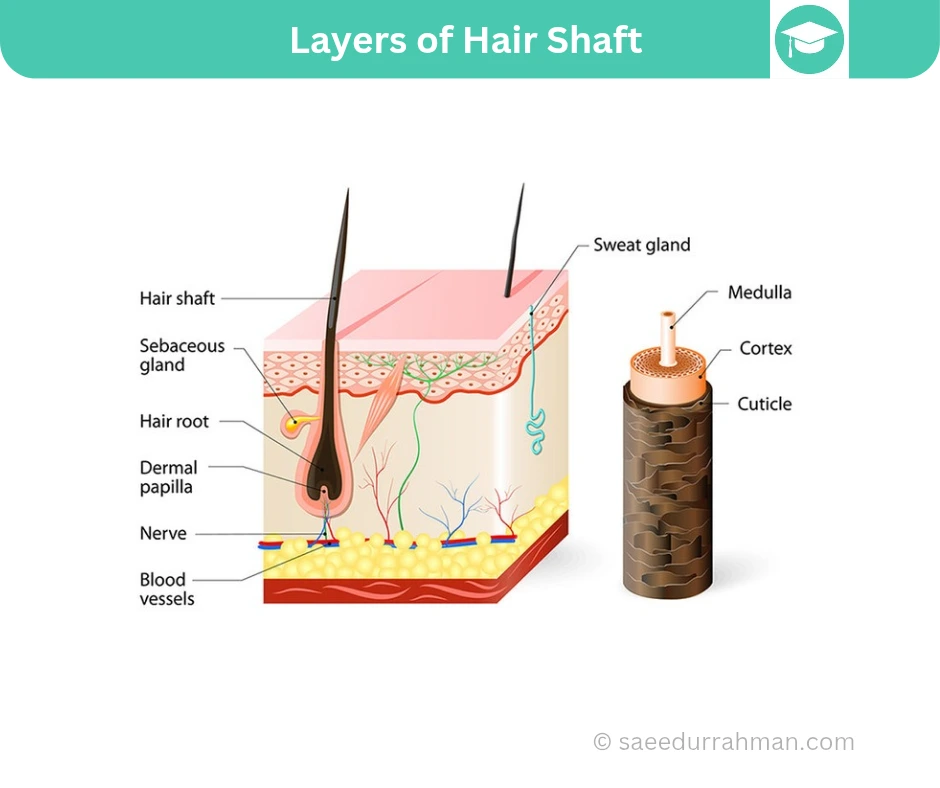
The Layers of the Hair Shaft
Introduction
The hair shaft is a critical structural component of human hair. It is visible above the skin surface and is composed of three distinct layers: Cuticle, Cortex, and Medulla. These layers are integral to the texture, strength, and overall health of hair.
Let’s delve into the anatomy and functions of these layers, their patterns, and their roles in maintaining healthy hair.
1. What is the Hair Shaft?
The hair shaft is the portion of hair visible above the skin’s surface. It is analogous to a pencil’s structure:
- The outer colored layer of a pencil represents the cuticle.
- The wooden part corresponds to the cortex.
- The graphite center mirrors the medulla.
The hair shaft is composed of keratinized (dead) cells that serve aesthetic and protective functions.
2. Layers of the Hair Shaft
The hair shaft consists of three distinct layers, each contributing uniquely to hair’s characteristics.
a. Cuticle Layer
-
Description: The outermost transparent layer made of 5-10 thin, non-pigmented, keratinized cells arranged like roof tiles or fish scales.
-
Function:
- Shields the cortex and medulla from damage caused by chemicals, pollutants, or physical stress.
- Controls water content and moisture balance.
- Reflects light, giving hair a shiny appearance.
-
Patterns:
- Coronal (crown-like, in rodents and bats).
- Spinous (petal-like, in seals and cats).
- Imbricate (flattened scales, typical in humans).
-
Impact of Damage:
- Healthy Cuticle: Smooth with intact scales, making hair shiny and strong.
- Damaged Cuticle: Jagged with exposed inner layers, leading to dull, brittle, and frizzy hair.
b. Cortex Layer
-
Description: The thickest intermediate layer, accounting for 90% of the hair shaft. It lies beneath the cuticle and surrounds the medulla.
-
Structure:
- Composed of cortical cells connected by intercellular lipoproteins.
- Contains pigment granules that determine hair color (e.g., melanin for black color, absence of melanin for gray/white hair).
- Encloses macrofibrils and microfibrils made of keratin protein.
-
Functions:
- Provides hair strength, elasticity, and texture.
- Determines hair’s natural color and resilience.
-
Special Feature: The hydrogen bonds and disulfide bonds in keratin proteins give the hair its flexibility and tensile strength.
c. Medulla Layer
-
Description: The innermost core of the hair shaft, also called the medullary canal or pith.
-
Structure:
- Composed of loosely packed, transparent cells and air spaces.
- May be fragmented, continuous, or interrupted depending on hair type.
-
Presence:
- Typically found in thick or coarse hair.
- Absent in finer hair types.
-
Function:
- Provides minimal structural support.
- May influence the hair’s insulating properties.
3. Practical Demonstration
Activity: Observing the Hair Shaft Under a Microscope
- Materials:
- Hair strands (different types: straight, curly, thick, fine).
- Microscope.
- Procedure:
- Examine the outer layer (cuticle) for its scale-like pattern.
- Observe the cortex for pigmentation and fibril structures.
- Look for the presence or absence of the medulla in various hair types.
Observation:
- Discuss how the differences in hair layers influence hair’s appearance and texture.
4. Discussion and FAQs
-
Why does damaged hair appear dull and frizzy?
- A damaged cuticle exposes the cortex, leading to moisture loss and rough texture.
-
What determines hair color?
- Melanin pigment in the cortex. Variations in its density and type (eumelanin for black/brown, pheomelanin for red) result in different hair colors.
-
Why is the medulla absent in fine hair?
- The medulla provides structural support in coarse hair, which is not as necessary for finer hair types.
-
How can we protect the cuticle layer?
- Avoid harsh chemicals, excessive heat, and rough brushing.
- Use conditioners to maintain moisture balance.
Conclusion
The hair shaft’s structure, particularly its layers (cuticle, cortex, and medulla), determines hair’s strength, texture, and appearance. A deeper understanding of these layers aids in maintaining healthy hair and identifying the causes of hair damage. By protecting the cuticle and supporting the cortex, we can enhance the overall health of our hair.
Would you like to explore hair follicle anatomy or the physiology of hair growth next?