
What Is ESR Test?
What Is ESR Test?
The erythrocyte sedimentation rate (ESR or sed rate) is the rate of sedimentation or settlement of RBCs at which red blood cells in anticoagulated whole blood settled in a standardized tube or EDTA tube over a period of one hour.
ESR is a common hematology test, and is a non-specific measure of inflammation.
Clinical Significance
- The Erythrocyte Sedimentation Rate (ESR) test is a commonly performed in the Hematology laboratory for the prognostic purpose that may indicate and monitor an increase in inflammatory activity within the body caused by one or more conditions such as chronic inflammatory disease, autoimmune disease, anemia, infections, and malignancies.
- The ESR test is not specific for any single disease but is used in combination with other tests to determine the presence of increased inflammatory activity.
- The ESR has long been used as a “sickness indicator” due to its reproducibility in both hematological and non hematological.
- When anticoagulated blood is allowed to stand undisturbed condition for a period of time, the erythrocytes tends to sink to the bottom.
- Two layers are formed, the upper plasma layer and lower sedimented erythrocyte layer. The rate at which the red cells fall is knows as Erythrocyte Sedimentation Rate (ESR).
Determination of ESR is done by several methods and their Specific Values:
Determination of ESR is done by several methods. These are as follows:
- Westergren method.
- Wintrobe method
- Landu method.
In the developing countries former two methods are used for ESR determination in the laboratory.
Wintrobe’s tube :
- It is 110 mm long tube with a 3.0 mm internal bore.
- It is graduated from ‘0’ upto ‘100’ mm (10 cm).
- The scale with the descending order is used for ESR determination.
- It is also used for Packed Cell determination.
Westergren’s tube :
- It is 300 mm long tube with a 2.5 mm internal bore.
- It is graduated from ‘0’ upto ‘200’ mm (20 cm).
- The scale with descending order is used for ESR determination.
- It is more specific then the Wintrobe’s method and others methods.
Normal value :
- By Westergren’s method :
Male : 0-15 mm/1st hour
Female : 0-20 mm/ 1st hour - By Wintrobe’s method :
Male : 0-9 mm/1st hour
Female : 0-20 mm/ 1st hour
High ESR Test Result (Red blood cells sink faster than normal):
May be caused by inflammation from conditions such as:
- Giant cell arteritis
- Arthritis
- Systemic vasculitis
- Polymyalgia rheumatica
- Inflammatory bowel disease
- Kidney disease
- Infections
- Rheumatoid arthritis and other autoimmune diseases
- Heart disease
- Certain cancers
Low ESR Test Result (Red blood cells sink slower than normal):
May be caused by conditions such as:
- Blood disorders:
- Polycythemia (increased red blood cells)
- Sickle cell disease (SCD)
- Leukocytosis (high white blood cell count)
- Heart failure
- Certain kidney and liver problems
Additional Notes:
Abnormal ESR results don’t always indicate a medical condition needing treatment.
ESR levels vary based on:
Age and sex
Pregnancy
Menstrual cycle
Aging
Obesity
Alcohol consumption
Exercise
Certain medicines and supplements can affect ESR results.
Determination Of ESR By Westergren’s Method :
Principle of the Test :
When anticoagulated blood is allowed to stand undisturbed condition for a period of time, the erythrocytes tends to sink to the bottom. Two layers are formed, the upper plasma layer and lower sedimented erythrocyte layer. The rate at which the red cells fall is knows as Erythrocyte Sedimentation Rate (ESR) and give the result as mm/1st hour.
Specimen :
- Patient should be fasting for 12 to 16 hours.
- Collect venous blood.
- 2.0 ml of blood is collected in a vial containing 0.5 ml of 3.8% Sodium citrate anticoagulant.
- Fasting EDTA (Ethyl Di-amine Tetra Acetic acid) anticoagulated whole blood is also used for ESR determination.
Requirements :
- Westergren’s tube with stand.
- Test tube with test tube rack.
- 3.8 % Sodium Citrate solution.
- Stop watch.
- Blood drawer.
Procedure :
- Blood drawer attached with clean and dry Westergren’s tube.
- Drawn 3.8% sodium citrate upto ‘150’ mark from ‘200’ mark in a test tube.
- Drawn well mixed anticoagulated blood upto ‘0’ mark from ‘200’ mark of the tube and mixed with 3.8% sodium citrate present in the test tube.
- Mixed well, filled the Westergren tube exactly upto ‘0’ mark (avoid air bubbles formation in the tube).
- Placed the tube upright position in the ESR stand, it should fit evenly into the groove of the stand and it allowed standing undisturbed condition exactly for 1 hour.
- Set the time in Stopwatch.
- Exactly after 1 hour, note the level to which the red cell column has fallen.
- Report the result in terms of mm/1st hour.
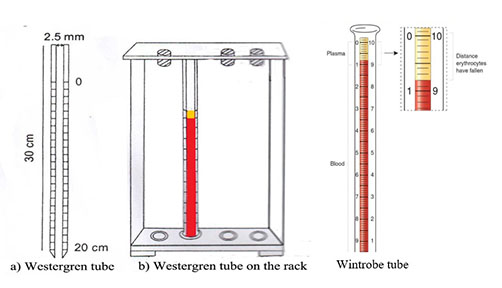
Determination Of ESR By Wintrobe Method :
Principle of the Test :
When anticoagulated blood is allowed to stand undisturbed condition for a period of time, the erythrocytes tends to sink to the bottom. Two layers are formed, the upper plasma layer and lower sedimented erythrocyte layer. The rate at which the red cells fall is knows as Erythrocyte Sedimentation Rate (ESR) and give the result as mm/1st hour.
Specimen :
Fresh fasting (12 to 16 hours fasting) Ethyl Di-amine Tetra Acetic acid (EDTA) anticoagulated and undiluted whole blood.
Requirement :
- Wintrobe’s tube with stand.
- Special Pasteur pipette attached with rubber tied.
- Stop watch.
Procedure :
- Mixed the blood carefully in the vial.
- Filled the Wintrobe’s tube to the ‘0’ mark by using a special Pasteur pipette.
- Placed the tube in exact vertical position in the stand.
- Set the Stop-watch for 1 hour.
- At the end of one hour note the level of erythrocyte column and give the result in terms of mm after first one hour (mm/ 1st hour).
Related Questions – Answers
Q1. What is the ESR Test?
Answer: The ESR (Erythrocyte Sedimentation Rate) test measures how quickly red blood cells (RBCs) settle at the bottom of a test tube containing anticoagulated blood over one hour. It’s a common hematology test used as a non-specific marker of inflammation.
Q2. Why is the ESR Test done?
Answer : The ESR test is used to:
-
Detect and monitor inflammation in the body.
-
Assist in diagnosing conditions like autoimmune diseases, chronic infections, anemia, and some cancers.
-
Track the progress of certain diseases or the effectiveness of treatments.
Q3. Is ESR specific to any disease?
Answer: No, ESR is not specific to a single disease. It is a general indicator of inflammation and should be interpreted alongside other clinical tests and findings.
Q4. How is ESR measured?
Answer: ESR can be determined by several methods:
-
Westergren Method (more commonly used, especially in developed countries)
-
Wintrobe Method
-
Landau Method (less commonly used)
Q5. What is the difference between Westergren and Wintrobe methods?
| Feature | Westergren Method | Wintrobe Method |
|---|---|---|
| Tube Length | 300 mm | 110 mm |
| Internal Bore | 2.5 mm | 3.0 mm |
| Measurement Range | 0-200 mm | 0-100 mm |
| Sensitivity | More sensitive and preferred | Less sensitive |